
Mold Testing Vs. Mold Inspection: What Do You Really Need And When?
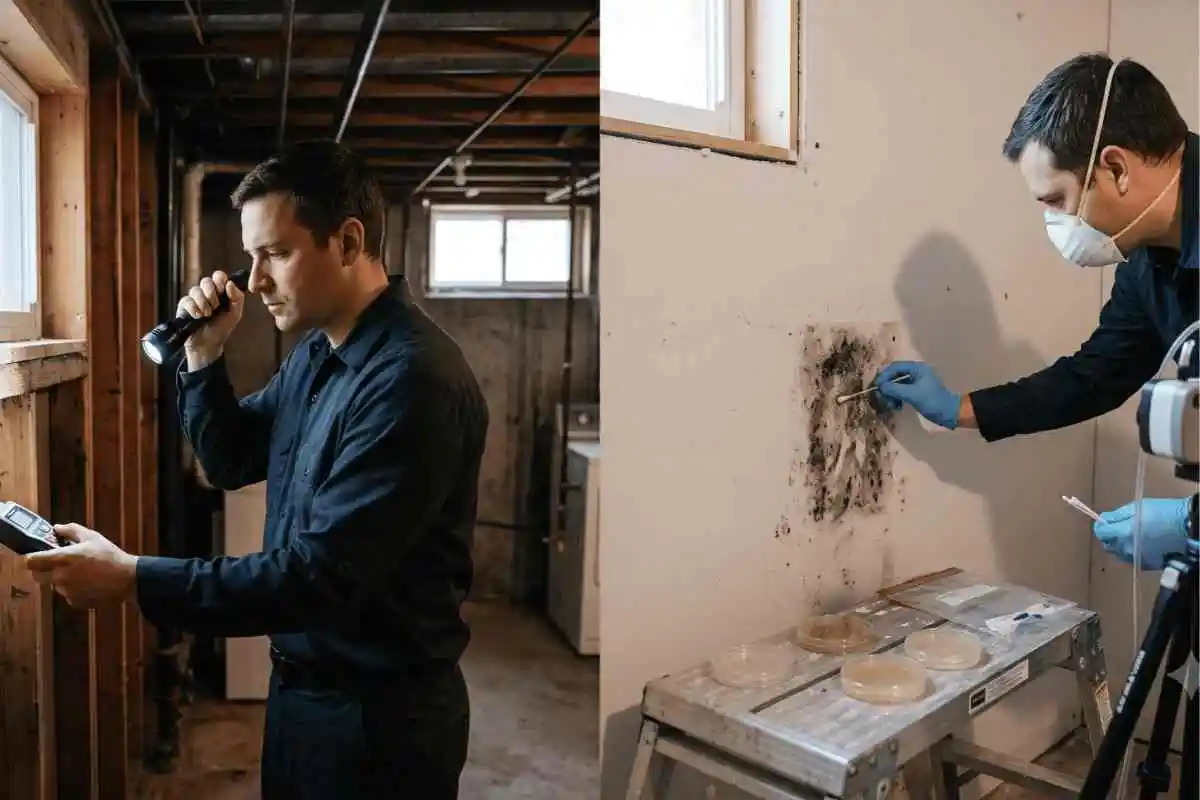
Have you noticed a musty smell in your home, a dark patch near a window, or a water stain on the ceiling that keeps coming back? Your first thought may be: Should I get a mold test?
Mold testing and mold inspection are different services, and most homeowners often get confused between the two.
In this guide, we’ll explain what each service does, when you need it, and how to decide what makes sense for your home.
|
Have a Mold Problem? Call Us Today! |
Mold Inspection vs. Mold Testing: What's the Difference?
|
Factors |
Mold Inspection |
Mold Testing |
|
Main purpose |
Find mold, moisture, and the source of the problem |
Analyze mold collected from air, surfaces, or materials |
|
What it may include |
Visual inspection, moisture readings, building history, and investigation of problem areas |
Air samples, tape lifts, swabs, or material samples |
|
Best for |
Leaks, visible mold, musty odors, water damage, or suspected hidden moisture |
Specific questions that require laboratory information |
|
Does it identify the cause? |
Often helps locate the moisture source |
Usually not by itself |
|
Does it identify mold types? |
Not always |
It may identify mold groups or types in the sample |
|
Is it always needed? |
Often a useful first step |
No |
What Does a Mold Inspection Actually Look For?
A professional mold inspection goes beyond looking for black or green spots on a wall. It looks for signs of mold, moisture, water damage, and conditions that could be allowing mold to grow and, most importantly, helps identify the source of the problem.
California public-health guidance specifically recommends looking for moisture because mold can be hidden beneath wallpaper, behind baseboards, inside walls, under flooring, and in other areas that are not immediately visible.
Note: Removing mold without correcting the moisture source may only give you a temporary result.
What Does Mold Testing Actually Tell You?
Mold testing involves collecting a sample and sending it to a laboratory for analysis. Professionals may use several methods to collect samples for mold testing -
1. Air Sampling
A device collects particles from the air for a set period. The sample can then be examined for mold spores.
An outdoor sample may also be collected in some investigations for comparison. However, mold levels can vary indoors and outdoors, so test results need to be interpreted carefully.
2. Surface Sampling
A swab or adhesive tape may be used on a suspicious surface. This can help determine what was collected from that specific location.
3. Bulk Sampling
The mold testing team takes a small piece of physical material (such as a square of drywall or carpet padding) to test inside a lab setting.
Testing can provide useful information in the right situation, but there is an important limitation: a sample only shows what was present in that location at that particular time. Airborne mold levels can change with ventilation, HVAC operation, indoor activity, and weather conditions.
Mold Testing or Mold Inspection: Which One Do You Need?
Not sure whether to get a mold test or an inspection? It depends on what you’re trying to find out.
|
Your Situation |
What You May Need |
|
You can see mold on a wall or ceiling |
Mold inspection to check the affected area and moisture source |
|
You smell mold but can’t find it |
Mold inspection, with testing if needed |
|
You suspect mold behind a wall |
Inspection and possibly testing to investigate further |
|
You want to identify mold in a sample |
Mold testing |
|
You need to check the results after cleanup |
Post-remediation inspection, with testing if appropriate |
What Happens After Mold Is Found?
Finding mold is only the beginning. The next step is correcting the conditions that allowed it to grow.
Depending on the situation, professional mold remediation services can often include isolating the work area, controlling airborne particles, removing all the contaminated porous materials, cleaning salvageable surfaces properly, and using HEPA filtration or other required controls.
The moisture problem also needs to be corrected. That could mean repairing plumbing leaks, roof leaks, drainage problems, crawl-space moisture, water intrusion around windows or walls, condensation, or ventilation problems.
If mold has spread into drywall, insulation, flooring, or other building materials, simply spraying the visible surface is unlikely to address everything behind it.
Depending on the extent of the damage, professional mold abatement or remediation may involve removing affected materials, cleaning surfaces, and controlling dust and airborne particles during the work.
|
Get Expert Mold Removal Today! - Contact Us Now! |
Common Questions About Mold Presence
1. Do I need a mold test if I can already see mold?
Usually, no. If you can see mold, you don’t need a lab test just to confirm it. You mainly need to find out what’s causing the moisture and address the affected area. Testing may still be useful if you need records or have a specific concern that requires further investigation. A professional offering mold remediation in Sacramento can inspect the area and help you decide what needs to be done.
2. Is a home mold testing kit accurate enough?
A home kit may collect mold, but that does not necessarily tell you whether you have an abnormal indoor mold problem. Mold spores occur naturally indoors and outdoors, and a basic kit usually cannot locate the moisture source or determine how far hidden damage extends. A professional moisture and mold inspection is usually more useful because it can help identify where the moisture is coming from, which areas are affected, and what may need to be addressed.
3. Should Sacramento homeowners check for mold after heavy rain or a roof leak?
Yes, during rain, water often enters the building and materials remain damp. If you notice stains, musty odors, swollen baseboards, bubbling paint, or damp areas in attics, crawl spaces, and walls, don't ignore it. Sometimes, the affected area might be hidden or extensive. That's where a professional inspection can help determine whether mold removal in Sacramento is required.
Takeaway
A mold inspection looks at the building, moisture, visible signs, and possible hidden problems, but mold testing analyzes a sample when there is a specific reason to collect one.
If you’re dealing with mold, you should not simply try to get a test result. It’s important to understand what is happening in the building and choose the right way to address it.
Read More About:
- Basement Mold Control: Expert Tips on Removal and Prevention
- What Is White Mold and Is It Dangerous?
- Discovered Orange Mold? Learn Causes, Risks & How to Prevent It
- Toxic Black Mold: 4 Signs To Watch Out For
Need Mold Removal or Remediation in Sacramento? JM Environmental Inc. Can Help
When mold has spread beyond a simple surface issue, JM Environmental, Inc. can help identify the affected area. We determine the appropriate approach for mold removal, mold abatement, and mold remediation Sacramento.
At JM Environmental Inc., we have 32 years of experience in hazardous-material abatement and demolition. Our fully licensed team (California License #693564 A, B, C-21, C-22, ASB, HAZ) is well-trained in containment, HEPA filtration, hazardous-material removal, and handling complex residential and commercial projects.
Along with mold services, we provide demolition services and asbestos removal services, helping property owners manage projects where several environmental or structural concerns overlap. These services are available throughout Sacramento, Stockton, Vacaville, and other parts of Northern California.
Whether you are dealing with visible mold, water damage, or a larger renovation involving hazardous materials, our expert team can help you determine the safest and most practical next step.
Give us a call at 866-726-0304 to schedule your service today!