
Is Friable Asbestos More Dangerous Than Non-Friable Asbestos?
Renovating or preparing a property for lease often brings up a critical question: does the building contain asbestos? If you are unsure about it, you are not alone. In such situations, professional Asbestos removal services can help property owners safely address asbestos-containing materials.
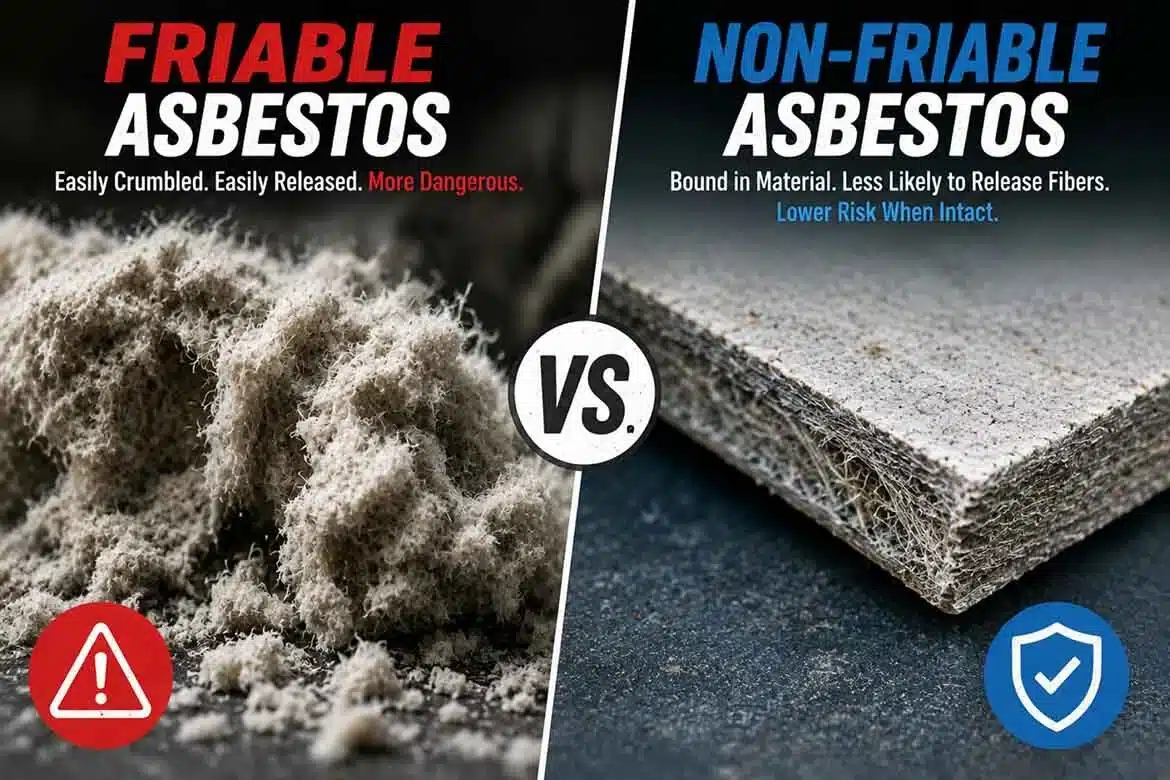
But did you know that there are two different types of asbestos: friable and non-friable? Both are known to be hazardous to health. Friable asbestos is far more dangerous, as it releases fibers into the air more easily. However, it is important to know whether asbestos is present in your building and the main differences between the two types.
In this article, we’ll compare friable and non-friable asbestos, explain which type poses a greater risk, and what to do if you suspect it is in your property.
|
Get Professional Asbestos Testing for Your Home - Call 866-726-0304! |
What Is Asbestos and Why Was It Used So Widely?
The group of naturally occurring fibrous silicate materials is known as "asbestos." These fall into two main groups:
- The Serpentine group consists of curly fibers in layered sheets and comprises chrysotile, also called white asbestos.
- The Amphibole group comprises straight needle-shaped fibers and includes crocidolite, amosite, anthophyllite, and Actinolite.
Asbestos has several advantages, including high tensile strength, heat resistance, affordability, and chemical stability. It can be woven into fabric, mixed into cement, or sprayed onto surfaces. Because of these properties, it was widely used in ceiling tiles, floor coverings, insulation, automotive brake pads, and roofing materials.
Despite being restricted, asbestos-containing materials are still found in buildings constructed before the 1980s.
What Is Friable Asbestos?
Friable asbestos is asbestos-containing material that can easily be crumbled, or reduced to powder, by hand pressure when dry.
- High Risk: Because microscopic fibers are loosely bound, sometimes making up 100% of the material, they easily become airborne when disturbed.
- Health Hazard: These fibers can be 700 times smaller than human hair; hence, they are invisible and can be inhaled easily.
- Common Examples: They are commonly used in soundproofing, pipe lagging, Sprayed-on fireproofing, boiler insulation, and steel beam coatings.
- Location: Mainly found in commercial and industrial settings and homes constructed or renovated during periods when asbestos was commonly used.
What Is Non-Friable Asbestos?
Non-friable or bonded asbestos comprises fibers tightly bound within a matrix of cement or resin that cannot be crumbled or reduced to powder due to hand pressure.
- Low Initial Risk: Comprises about 15% asbestos and does not release measurable fibers into the air as long as it stays intact and undisturbed.
- Common Examples: Used in corrugated roofing, asbestos cement sheets (fibro/AC sheeting), vinyl floor tiles, textured paint, shingles, and bitumen waterproofing.
- Location: Non-friable asbestos is generally found in residential homes.
- Crucial Caveat: It can become friable when damaged, severely weathered, crushed, or subjected to sanding, cutting, or sawing.
Friable vs. Non-Friable Asbestos
|
Feature / Aspect |
Friable Asbestos |
Non-Friable Asbestos |
|
Core Difference |
Releases fibers easily into the air. |
Does not release fibers easily when intact. |
|
Physical Characteristics |
Loose, powdery, and can be easily crumbled with your hand. |
Solid and rigid; cannot be crumbled with your hand. |
|
Structure & Binding |
Unbound/loose material with no strong binder holding fibers in place. |
Fibers are locked in place by cement or another binding agent. |
|
Effort Required to Airborne Fibers |
It does not take much effort to send fibers floating into the air you breathe. |
Fibers remain trapped as long as the material is in good condition and left alone. |
|
Hazard Level (Intact State) |
Higher potential for fiber release and constant risk of fiber inhalation. |
Lower risk while intact, but not harmless or completely safe. |
|
Impact of Renovation / Damage |
High risk of fiber release even with minor disturbance. |
Can become friable when cut, sanded, broken apart, or disturbed (e.g., cutting a wall, sanding a floor, breaking a roof). |
|
Post-Damage Risk Level |
Maximum hazard. |
Just as dangerous as any loose asbestos product once rendered friable. |
Note: The main difference lies in how easily asbestos fibers become airborne. Non-friable asbestos generally poses a lower risk when it remains intact and undisturbed, but it is not considered safe to handle without proper precautions. Cutting, sanding, drilling, crushing, or otherwise damaging it can release asbestos fibers.
Why Is Friable Asbestos More Dangerous
Friable asbestos is more dangerous because of the increased risk of fiber release with minimal disturbance. If inhaled, these asbestos fibers can increase the risk of serious diseases, including asbestosis, lung cancer, and mesothelioma.
Research states that there is no known safe level of asbestos exposure, and a single exposure can be risky for health. Such diseases develop slowly, as the symptoms take almost 20 to 30 years to show after exposure; by then, the disease would have already advanced.
That’s why friable asbestos should be treated with extreme caution.
Can Non-Friable Asbestos Become Dangerous
Yes, not many people know, but even non-friable asbestos can be dangerous when damaged, disturbed, or deteriorating.
When damaged, the non-friable asbestos releases fibers once the cement matrix breaks down. Such wear and tear can result from demolition, renovation, extreme weather events, or drilling, sawing, or sanding.
Once asbestos becomes brittle, even non-friable material starts to shed fibers. A common example is vinyl asbestos floor tile, which is safe when intact and covered by another flooring material. But when broken during removal, these turn into toxic dust.
This is why professional asbestos testing is so important. You cannot simply assume that non-friable materials are safe to disturb. You need to know what you are dealing with before you start any work.
|
Safe Handling of Asbestos by Professionals - Contact Us Now! |
How to Identify Asbestos in Your Home or Business
As the fibers are microscopic, one cannot identify asbestos simply by looking at it. The only way to know for sure that a material contains asbestos is by having it tested in a certified laboratory.
Likewise, if your building was constructed before 1980, you need to assume that asbestos will be present. These are commonly found in boiler insulation, pipes, ceiling tiles, floor tiles, plaster, cement panels, textured paints, and roofing materials.
It is recommended not to disturb the material if you suspect it contains asbestos, as it can release toxic fibers into the air.
Contact a licensed professional for asbestos testing in your local area.
How Is Asbestos Tested?
Professional asbestos testing follows a careful process to avoid disturbing the material unnecessarily.
- First, a qualified professional identifies the material that needs to be tested and determines where a sample can be collected.
- A small sample is then carefully taken from the suspected asbestos-containing material and sent to a qualified laboratory for analysis.
- The laboratory examines the sample to determine whether asbestos is present.
- Once the results are available, they can help determine the appropriate next step.
If asbestos is found, the material may be left undisturbed, managed in place, or removed depending on its condition, location, and the work planned around it.
If you need asbestos testing, professional testing can help you know what is present before renovation, demolition, or repairs begin.
What Does Professional Asbestos Removal Involve?
Rigorous processes are conducted to ensure utmost compliance and safety by the professional asbestos abatement and asbestos removal services.
Once asbestos-containing material has been identified and removal or abatement is determined to be necessary, professionals follow a series of safety measures to contain the area and prevent fiber release.
The experts work by containing the area using plastic sheeting and negative air pressure systems. Even the workers onsite wear protective clothing and respirators equipped with HEPA filters.
The asbestos-containing materials are removed carefully, wetted down to prevent fiber release, and then placed within sealed containers for proper disposal.
Once the removal is completed, the area is cleaned using wet wiping and HEPA vacuums. Later, air samples are collected to confirm if the area is safe to be reoccupied.
Common Questions About Asbestos Removal
1. Can I remove asbestos myself?
No, absolutely not. Asbestos removal should not be treated as a DIY project. Depending on the type of material, the size of the job, and local regulations, the work may need to be done by trained or licensed professionals who know how to contain the area, remove the material safely, and dispose of it properly.
2. How do I know if my building has asbestos?
This can only be determined by testing the material in a certified laboratory. A licensed asbestos consultant conducts a proper inspection, collects samples cautiously, and then gets them analyzed. However, if your building is from before 1980, it is safe to assume that there will be toxic levels of asbestos present in it. In such a case, call a professional for asbestos testing in Sacramento or your local area.
3. What happens if I disturb asbestos accidentally?
If you accidentally disturb asbestos-containing material, stop whatever you are doing, vacate the area, and do not allow anyone else to enter. Call a licensed asbestos abatement professional right away to analyze the situation, contain the area, and perform professional cleanup and removal. Bear in mind that every minute counts when dealing with accidental asbestos disturbance.
Final Thoughts
Asbestos is hazardous to your health, and you should not attempt any DIY with it. Be it friable or nonfriable, it still poses a serious risk to your health and everyone who enters this high-risk area. While the difference between the two asbestos types matters, handling should be done only by a professional.
So, be sure to call a licensed professional for asbestos testing in your local area. Finally, take all the necessary steps to protect yourself, your employees, or your family from the toxic effects of this hazardous substance.
Read More About:
- Can Undisturbed Asbestos Be Dangerous? Learn the Facts
- What to Do Before a Home or Building Asbestos Inspection
- How to Identify Asbestos Safely: Can You See or Smell It?
- How Modern Technology Helps Detect and Remove Asbestos
Don’t Wait Until It Is Too Late; Manage Asbestos With JM Environmental Inc.
If you are also planning a renovation in your old building in Sacramento or the nearby area, you might be looking for a professional asbestos inspection. That’s where JM Environmental Inc. can help.
With more than 30 years of experience in demolition and safe handling of hazardous materials, we’re Sacramento locals' first choice. Our company is a registered contractor licensed by the state of California and the state of Nevada.
- California License #693564 A, B, C-21, C-22, ASB, HAZ
- Nevada License #0073480 A-13, A-22, A-23
As a BBB-accredited company with an A+ rating, we provide professional asbestos testing and asbestos abatement in Sacramento. Our other services include demolition services, lead removal, mold removal, and fire debris cleanup.
We also serve property owners and businesses in Stockton and Vacaville, helping them address hazardous materials and environmental cleanup needs safely and professionally.
Do not allow asbestos to put your health at risk. Call us today at 866-726-0304 to schedule an asbestos inspection.