
Mold Remediation vs Mold Removal
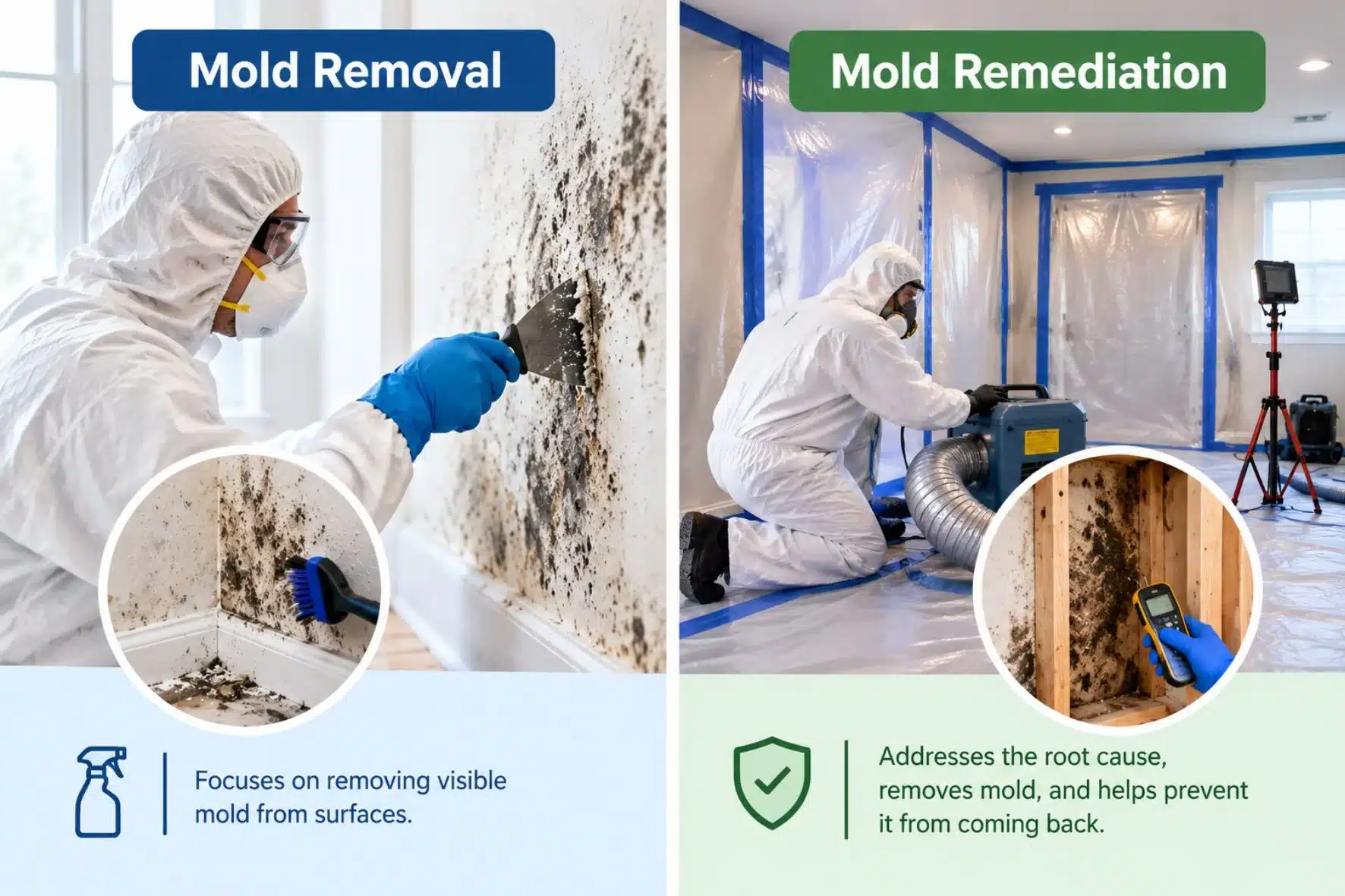
Finding mold in your home or business can raise an immediate question: Do you just need the mold removed, or do you need full mold remediation?
These terms sound similar, but they do not always mean the same thing.
Mold removal generally focuses on getting visible mold off a surface. Mold remediation means takes a broader look at the problem, including the moisture source, hidden growth, affected materials, containment, cleaning, and steps to prevent the mold from returning.
So, which one do you need? Let’s break down the difference and what to expect when dealing with a mold problem.
| Stop Mold Before It Spreads - Contact Us Now! |
What Is Mold and Why Does It Grow Indoors?
Mold is a type of fungus that naturally exists both indoors and outdoors. Mold spores are present indoors and outdoors, but they become a problem when they come into contact with a damp surface and begin to grow.
Indoor mold is commonly linked to:
- Plumbing leaks
- Roof or window leaks
- Flooding and water damage
- High indoor humidity
- Poor ventilation
- Condensation
- Damp crawl spaces, basements, or attics
Because mold requires moisture to thrive, cleaning surface growth without resolving the underlying leak or humidity issue allows it to return quickly. For example, if mold is growing under a bathroom sink, wiping the cabinet may remove what you can see. But if a small plumbing leak is keeping the area damp, the mold problem may return.
The CDC also recommends fixing water issues simultaneously with mold cleanup.
Mold Removal vs. Mold Remediation: What’s the Difference?
The simplest way to understand the difference is this:
Mold removal focuses on getting rid of mold that is present. Mold remediation looks at the entire problem, including where the mold is growing, how far it has spread, what moisture caused it, and how contaminated materials should be handled. Here is the difference between mold removal and mold remediation
| Factor | Mold Removal | Mold Remediation |
| Main focus | Removing visible mold | Addressing mold and its source |
| Scope | Usually limited | More comprehensive |
| Moisture source | May not be addressed | Identified and corrected |
| Hidden mold | May be missed | Area is assessed for hidden growth |
| Containment | May not be needed for small areas | Often used for larger projects |
| Air filtration | Usually limited | HEPA filtration may be used |
| Damaged materials | May not be included | Contaminated materials may be removed |
| Recurrence | May not address the cause | Includes steps to reduce recurrence |
| Best for | Small, surface-level problems | Hidden, widespread, recurring, or water-related mold |
Mold removal can therefore be one part of a larger remediation project. Professional remediation generally involves assessing the problem, controlling the source of moisture, containing the affected area when needed, removing contaminated materials, and cleaning the space.
What Is Mold Remediation Process?
A professional mold remediation may include these steps:
1. Inspection and Assessment
The first step is finding out where the mold is and what may have caused it. A professional may look for visible growth, musty odors, water damage, plumbing leaks, damp materials, and signs of mold behind walls or other building components.
2. Fixing the Moisture Source
Mold needs moisture to grow, so removing the mold is only part of the solution. The source of the moisture, whether it is a leaking pipe, roof leak, flooding, condensation, or excessive humidity, also needs to be addressed. Otherwise, the mold may return even after cleanup.
3. Containment
When contaminated materials are disturbed, mold particles can become airborne and spread to other areas. For larger remediation projects, containment may be used to help keep the affected area separated from clean areas.
4. HEPA Air Filtration
During mold cleanup, tiny particles can spread through the air. Professionals use HEPA air scrubbers and vacuums to capture these particles and help keep them from spreading. And these tools work alongside containment to help keep nearby areas clean.
5. Cleaning and Material Removal
Some materials can be cleaned, but heavily contaminated porous materials might need to be removed. The appropriate method always depends on the material, the extent of contamination, and the condition of your property.
6. Final Cleaning and Verification
After the affected materials have been addressed, the area is cleaned, and the project may include post-remediation verification when appropriate.
When Do You Need Mold Remediation?
Not every small spot of mold requires a large remediation project.
The EPA suggests using 10 square feet as a benchmark for considering professional remediation, although the right approach also depends on the type of water damage, location, materials affected, and other conditions.
Even a small patch of visible mold may not show the full extent of the problem. Mold can sometimes spread behind drywall or other materials, where it may remain hidden until the affected area is opened.
In some cases, the problem may be more than a simple cleanup can handle. Professional mold remediation may be needed when:
- Mold covers a large area.
- Mold keeps coming back after cleaning.
- There has been flooding or significant water damage.
- Mold may be behind walls, ceilings, or other hidden areas.
- Drywall, insulation, carpet, or other porous materials are affected.
- You notice a strong, persistent musty odor but cannot find the source.
- The moisture problem has not been identified or corrected.
- The work could spread mold into other parts of the property.
Can You Remove Mold Yourself?
For a small area on a hard, washable surface, basic cleaning may be possible, but larger or hidden mold problems are different.
Disturbing moldy drywall, insulation, carpet, or other contaminated materials can release particles into the air. That’s why the CDC always recommends protective equipment like an N95 respirator, gloves, and eye protection during mold cleanup.
Professional help makes more sense when the affected area is large, the source is unknown, water damage is involved, or contaminated materials need to be removed.
This is also why simply painting over mold is not a solution. The moisture problem and existing mold need to be addressed first.
What Causes Mold to Come Back After Removal?
Mold can return when the conditions that allowed it to grow are still present. Common reasons include:
- An unrepaired plumbing leak
- Roof or window water intrusion
- Excess indoor humidity
- Poor bathroom ventilation
- Damp insulation or drywall
- Condensation
- Water-damaged materials that were not properly addressed
This is one of the biggest differences between simply cleaning visible mold and addressing the complete problem. If the moisture source remains, cleaning the surface may only provide a temporary fix.
| Suspect Mold Growth? – Get a Professional Inspection! |
Mold Removal and Mold Remediation: Which Option Do You Need?
Mold removal may be reasonable when the mold:
- Covers a very small area
- Is growing on an accessible surface
- Was caused by a moisture problem that has already been corrected
- Has not spread into walls, insulation, flooring, or HVAC components
Professional mold remediation should be considered when:
- Mold covers a larger area
- Mold repeatedly returns after cleaning
- You smell mold but cannot locate it
- Water has entered walls, ceilings, or flooring
- There has been major water damage
- Mold may be inside an HVAC system
- Contamination is found in hard-to-reach areas
- Porous building materials are heavily affected
- You are unsure how far the problem has spread
Hidden mold requires special care because disturbing moldy material can release spores into the surrounding area. The EPA also recommends considering an experienced professional when hidden mold is suspected.
Frequently Asked Questions
1. How quickly can mold grow after water damage?
Mold can start growing on wet materials within 24 to 48 hours after water damage if they remain damp. That’s why the CDC recommends drying wet areas and materials as quickly as possible to help prevent mold growth.
However, 48 hours is not an exact deadline for every surface. How quickly mold develops can depend on factors such as temperature, moisture levels, the type of material, and airflow.
Still, if your property has experienced flooding, a plumbing leak, or another water event, don't wait for a musty smell or visible mold before taking action.
2. Do I need mold testing before remediation?
Not always. The EPA says testing is usually not needed if mold is already visible. It may be worth testing if you cannot find the source, suspect mold behind walls or other hidden areas, have health concerns, or need a record for legal reasons. Testing may also be performed after cleanup to verify whether remediation was successful. If testing is needed, a mold removal expert can recommend the right type of testing for your situation.
3. Can Sacramento homes develop mold after roof leaks or rainy weather?
Yes. Mold does not require a constantly humid climate. A roof leak, plumbing problem, damp crawl space, condensation, or water trapped inside building materials can provide enough moisture for growth. Sacramento property owners should pay particular attention to areas affected by leaks and make sure wet materials are dried promptly. Professional mold remediation can help when contamination has spread beyond an easily cleaned surface.
Takeaway
The difference between mold removal and mold remediation comes down to how completely the problem is addressed.
Cleaning visible mold may solve a small, isolated problem, but larger or recurring contamination often requires a broader approach. Finding the moisture source, preventing contamination from spreading, safely handling affected materials, and thoroughly drying the area are all important parts of successful remediation.
The sooner the moisture and mold are addressed, the better your chances of limiting damage to your property.
Read More About:
- Basement Mold Control: Expert Tips on Removal and Prevention
- What Is White Mold and Is It Dangerous?
- Mold Removal Made Simple: Concrete Floors, Walls & Patios
- Toxic Black Mold: 4 Signs To Watch Out For
Need Mold Remediation in Sacramento? Contact JM Environmental Inc.
If you have found visible mold, discovered moisture damage, or are dealing with a musty odor that will not go away, JM Environmental, Inc. can help.
We’re a licensed company (California License #693564 A, B, C-21, C-22, ASB, HAZ) with 32 years of experience handling hazardous-material abatement, demolition, and mold-related projects. We provide professional mold remediation sacramento and mold abatement in Sacramento, as well as in Stockton and Vacaville.
As a BBB-accredited company with an A+ rating, our skilled team at JM Environmental Inc. uses containment barriers, HEPA filtration, specialized cleaning methods, and established safety procedures for mold remediation projects.
Call 866-726-0304 to schedule professional service.